On June 7, experts from the German employers’ organization NORDMETAL Gunter Trepte and Henry Zimmermann and Deputy Director of the Department for the Development of Employment and Corporate Social Responsibility of the Federation of Employers of Ukraine Anatoly Garmash visited the University.
The guests met with Rector Anatolii Ukrainets, Vice-rector for scientific-pedagogical and educational work Larisa Arsenieva and Vice-rector for scientific work Alexander Shevchenko, where they discussed a new strategy of introducing dual education at our university, taking into account the experience of German colleagues.
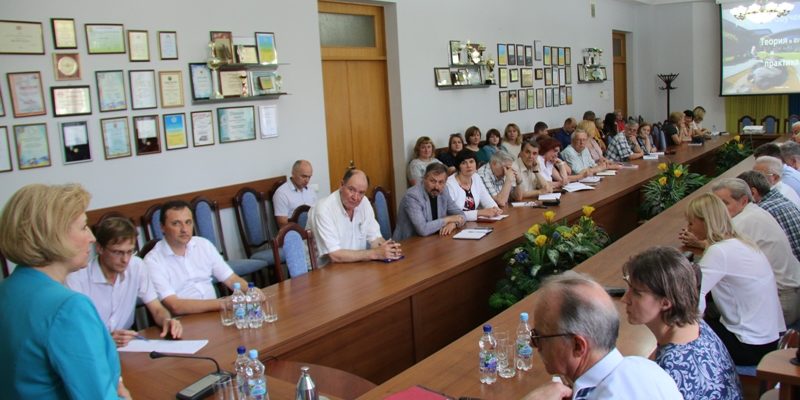
During the visit to NUFT experts also held a seminar “Dual education in small and medium-sized enterprises: experience of Germany”, which was attended by the heads of educational units of our university and lecturers of graduation departments.
Germany is the founder of dual education. It is from this system of training specialists adopted Canada, Austria and other countries. So the experience of German colleagues is very interested in our team.
Henry Zimmermann presented two models of dual education working on the NORDMETAL initiative – at Nordakademie – a private higher education institution founded 25 years ago as a pilot for the design and implementation of dual education and at the Technical University of Hamburg, State University of Hamburg where dual education has been implemented and successfully realized for 15 consecutive years. The concept of dual education in the latter lies in the joint development of curriculum selective disciplines training specialist’s employers and universities.
The specialist said that gradually the employers, feeling the urgent need for qualified personnel of engineering direction, came to the need to actively engage in the professional training of such personnel. At the same time to popularize the technical sciences, they start from kindergarten and school, organizing campuses, in particular in robotics. He presented data on the costs and benefits of enterprises in the preparation of students in dual form, described the benefits for employers and students, shared the experience of this form in small and medium-sized companies and spoke about social partnership and selection of candidates for dual training.
In his turn, Anatoly Garmash, Deputy Director of the Department for the Development of Employment and Corporate Social Responsibility of the Federation of Employers of Ukraine, commented on the readiness of Ukrainian employers to finance the training of specialists in dual training. He cited examples (so far, few) of the successful implementation of such a model in Ukraine and stressed that employers are also interested in the scientific component of specialist training, in their basic education. However, the employer needs a specialist who will be trained according to his needs. And this should be a common task of the higher education institution and the employer. He reminded that normative documents are being prepared at the Ministry of Education and Science of Ukraine for implementation of the dual education system in our country. With regard to the position of the Federation of Employers, it is that dual education should be complete, with the formal conclusion of a tripartite agreement with a student, where each party (employer, university, student) bears its responsibility. The expert emphasized that the issue is a priority for the Federation; however, there is an understanding that dual education cannot be a mass phenomenon. In Germany, for example, only about 20% of businesses are willing to finance dual education.
In addition, Mr Garmash is an employer representative at the National Agency for Quality Assurance in Higher Education, which will, in addition to his other mandate, be responsible for accrediting higher education programs. The specialist reminded that one of the criteria for evaluating the programs submitted for accreditation would be their coordination with employers, as well as monitoring the graduates’ professional success under these programs. Therefore, Ukraine’s employers are finally becoming active participants in the process of training specialists in all sectors of the economy.
The information received from the experts prompted our teachers and scientists to actively discuss and a large number of questions to the speakers.
At the end of the seminar, Vice-rector Larisa Arsenieva thanked the participants of the event and wished all the inspiration and successful use of the experience of German colleagues in improving the dual education system at our university. After all, some departments of our university already have the first successful experience in implementing this form of training.
Recall that a dual education system involves a combination of classroom and on-the-job training, which is not to be confused with practice. In this case, the young specialist is prepared by the educational institution and the enterprise. The company defines the specialties it needs, provides its proposals for the formation of appropriate curriculum and finances the education of students who have chosen these specialties. At the same time, students immediately start studying at the company, receiving salaries, regardless of where they study this month – at university or at the company.